
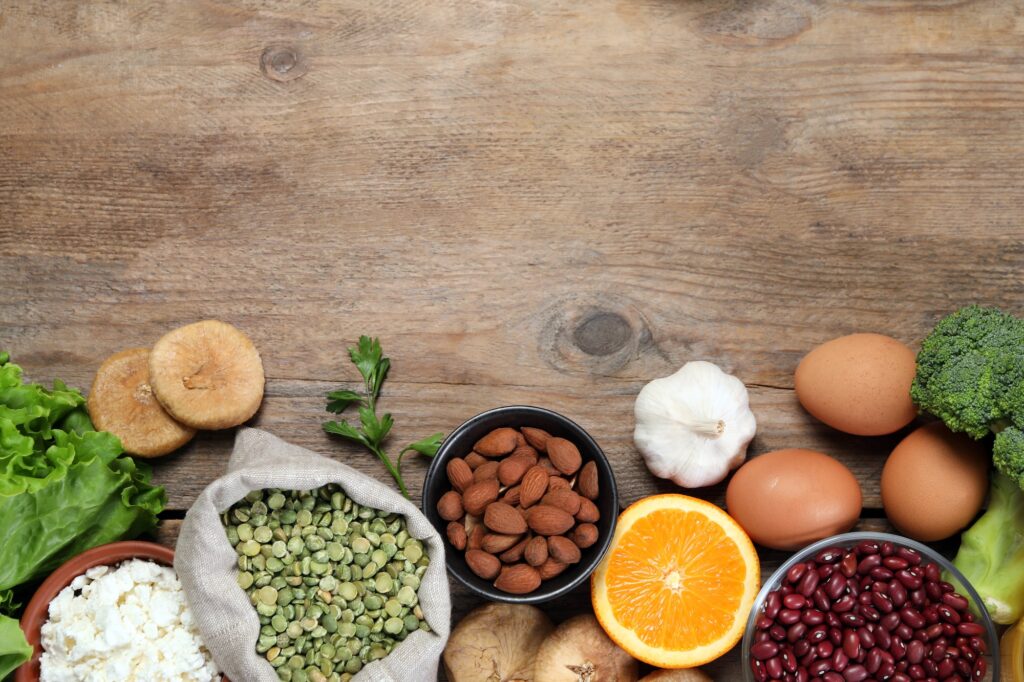
Food is the foundation. B-vitamin supplements exist to fill small gaps that food doesn’t cover — not to replace what a decent diet already provides. And once you understand where B-vitamins actually come from and how to get more out of them, you’ll realize most people don’t need the mega-doses the supplement industry sells.
Here’s what every B-vitamin does, where to find it in food, how to prepare food to preserve the nutrients, and when supplementation genuinely matters.
Why Food Beats Supplements as Your Primary Source
Food contains the cofactors your body needs to actually use B-vitamins.
A B-vitamin in isolation (what you get from a supplement) is one chemical. The same B-vitamin in food comes packaged with minerals, fats, fiber, enzymes, and other compounds your body evolved to process it alongside. That bundle improves absorption, utilization, and the overall benefit you get.
Food provides moderate doses matched to how your body uses them.
A cup of spinach contains about 263 mcg of folate. A B-Complex often delivers 2,000+ mcg. Your body doesn’t process the mega-dose any better — it just has to work harder to clear what it can’t use.
Food reduces the risk of overdose and side effects.
B-vitamin toxicity from food is nearly impossible. B-vitamin toxicity from supplements (especially B6 at mega-doses) is real and well-documented. Food-sourced B-vitamins give your body the safety margin it needs.
That said — food alone isn’t always enough. We’ll cover who needs supplementation and why near the end of this article.
The Eight B-Vitamins and the Best Foods for Each
Vitamin B1 (Thiamin)
What it does: Converts carbohydrates into energy, supports nerve function, maintains healthy brain and muscle activity.
Daily need: 1.1-1.2 mg for most adults.
Top food sources:
- Sunflower seeds — one quarter cup contains ~0.4 mg
- Lentils and black beans — one cup contains ~0.3 mg
- Trout and salmon
- Nutritional yeast
Who’s at risk of deficiency: Heavy alcohol users, people with eating disorders, long-term diuretic users.
Vitamin B2 (Riboflavin)
What it does: Energy production, antioxidant function, nerve health, migraine prevention.
Daily need: 1.1-1.3 mg for most adults.
Top food sources:
- Beef liver (extraordinarily high — 3 oz contains 2.9 mg, more than twice the daily need)
- Dairy products (milk, yogurt, cheese)
- Eggs
- Almonds — one ounce contains 0.3 mg
- Mushrooms
- Lean beef and poultry
- Spinach
Note: Riboflavin is sensitive to light. Milk sold in clear containers loses significant B2 over time. Opaque or carton packaging preserves it better.
Vitamin B3 (Niacin)
What it does: Energy metabolism, cardiovascular health, cholesterol regulation, skin health.
Daily need: 14-16 mg for most adults.
Top food sources:
- Chicken breast — 3 oz contains ~10 mg
- Turkey — 3 oz contains ~6 mg
- Tuna — 3 oz contains ~11 mg
- Beef liver — 3 oz contains ~15 mg
- Peanuts — one ounce contains ~4 mg
- Mushrooms
- Brown rice
- Avocado
Note: Your body can convert the amino acid tryptophan into niacin, so protein-rich diets usually meet niacin needs easily.
Vitamin B5 (Pantothenic Acid)
What it does: Supports adrenal function, hormone production, energy metabolism, wound healing.
Daily need: 5 mg for most adults.
Top food sources:
- Chicken (especially organ meats)
- Egg yolks
- Avocado — one whole avocado contains ~2 mg
- Mushrooms (shiitake especially)
- Sunflower seeds
- Sweet potatoes
- Broccoli
- Lentils
Note: B5 is in nearly all whole foods — true deficiency is rare in people eating a varied diet.
Vitamin B6 (Pyridoxine)
What it does: Neurotransmitter production (serotonin, dopamine, GABA), hemoglobin formation, immune function.
Daily need: 1.3-1.7 mg for most adults.
Top food sources:
- Chickpeas — one cup contains ~1.1 mg (about 65% DV)
- Salmon and tuna — 3 oz contains ~0.9 mg
- Chicken breast
- Beef liver
- Potatoes (with skin) — one medium contains ~0.4 mg
- Bananas — one medium contains ~0.4 mg
- Pistachios and walnuts
Caution: Pyridoxine supplements at 100+ mg daily can cause nerve damage over time. This is one of the few B-vitamins where mega-dosing has real, documented risk.
Vitamin B7 (Biotin)
What it does: Supports hair, skin, and nail health; aids metabolism of fats and carbohydrates.
Daily need: 30 mcg for most adults.
Top food sources:
- Egg yolks (raw egg whites contain avidin, which binds biotin)
- Almonds, walnuts, peanuts
- Salmon
- Sweet potatoes
- Cauliflower and broccoli
- Mushrooms
- Avocado
Note: Deficiency is rare but can occur in people who eat large amounts of raw egg whites or have long-term intestinal issues.
Vitamin B9 (Folate)
What it does: DNA synthesis, red blood cell formation, nervous system development, especially critical during pregnancy.
Daily need: 400 mcg DFE for most adults; 600 mcg DFE during pregnancy.
Top food sources:
- Leafy greens (spinach, kale, romaine, arugula) — one cup cooked spinach contains ~263 mcg
- Legumes (lentils, chickpeas, black beans) — one cup lentils contains ~358 mcg
- Asparagus — half a cup contains ~134 mcg
- Avocado
- Broccoli and Brussels sprouts
- Oranges and strawberries
- Beef liver
Vitamin B12 (Cobalamin)
What it does: Nerve function, red blood cell formation, DNA synthesis, energy production.
Daily need: 2.4 mcg for most adults (though absorption declines significantly with age, so higher intake is often beneficial after 40).
Top food sources:
- Beef liver — 3 oz contains ~70 mcg (extraordinarily high)
- Clams — 3 oz contains ~84 mcg
- Fish (salmon, trout, sardines, tuna)
- Beef, lamb, pork
- Chicken and turkey
- Dairy products
- Eggs
Important: B12 is found almost exclusively in animal products. Vegans and vegetarians usually need to supplement, as do many adults over 40 due to declining stomach acid and intrinsic factor production.
How to Prepare Food to Preserve B-Vitamins
B-vitamins are water-soluble and heat-sensitive. How you prepare food affects how much B-vitamin content actually makes it into your body.
Preparation that preserves B-vitamins:
- Light steaming instead of boiling (less nutrient leaching into water)
- Quick stir-frying rather than long cooking
- Eating raw when safe (leafy greens, bell peppers, avocado)
- Fermenting (sauerkraut, kimchi, yogurt actually increases some B-vitamin content thanks to bacterial activity)
- Soaking grains and legumes before cooking to reduce phytates that block absorption
- Combining B-vitamin foods with fats (B-vitamins work better alongside healthy fats like olive oil, avocado, or nuts)
- Keeping dairy and liquids in opaque containers (B2 is destroyed by light)
Preparation that destroys B-vitamins:
- Boiling vegetables and discarding the water — a huge amount of folate and other B-vitamins leach out
- Overcooking — folate loses 50-90% of its content with extended heat
- Microwaving on high for extended periods
- Deep frying at high temperatures
- Prolonged storage — fresh produce has more B-vitamin content than old produce
- Excessive processing — refined grains lose most of their B-vitamin content during milling (which is why “enriched” grains have B-vitamins added back after the fact)
A simple rule: the more a food resembles its natural state and the gentler the preparation, the more B-vitamin content survives.
A Practical “Food First” Framework
If you want to actually improve your B-vitamin intake through diet, here’s where to start:
Step 1: Audit what you’re eating.
Spend one week logging what you eat. Not calories — just the foods. At the end of the week, look at how often you’re eating:
- Leafy greens
- Beans and lentils
- Eggs
- Fish or seafood
- Lean meat or poultry
- Dairy (if tolerated)
- Nuts and seeds
- Whole grains
If any of these appear less than 3-4 times per week, that’s a gap to close.
Step 2: Add one food target per week.
Don’t try to overhaul your diet overnight. Pick one category you’re low on and commit to adding it 3-5 times in the next week. Spinach in your eggs. Lentils in your soup. Salmon once this week. Small, sustainable additions compound faster than ambitious changes.
Step 3: Reduce the foods that deplete.
Processed foods, refined grains, excessive sugar, and heavy alcohol all drain B-vitamins while providing few of them. You don’t have to eliminate anything perfectly — just reduce the stuff that takes without giving back.
Step 4: Supplement for a small gap.
For most people, the gap is small — which is why moderate-dose supplements (not mega-dose formulas) are the right choice.
Who Still Needs Supplementation Beyond Food
Food is the foundation, but it isn’t always enough. Several groups benefit from thoughtful B-vitamin supplementation:
People over 40. Stomach acid production declines with age, which reduces absorption. Intrinsic factor (the protein that transports B12) also declines. Even people eating plenty of whole foods and food varieties can be deficient after 50.
Vegans and vegetarians. B12 is almost exclusively found in animal products. Plant-based eaters must supplement.
People taking certain medications. Metformin (diabetes medication), PPIs (Prilosec, Nexium), H2 blockers (Zantac, Pepcid), and long-term birth control all interfere with B-vitamin absorption.
People with digestive issues. SIBO, IBD, celiac disease, and post-bariatric surgery patients often have impaired absorption.
MTHFR carriers and people with methylation gene variants. These variants don’t cause deficiency directly, but they affect how your body uses B-vitamins once absorbed, making adequate intake more important – Learn more
Chronically stressed people. Cortisol and chronic stress deplete B-vitamins faster than normal intake replaces them.
For all of these groups, supplementation isn’t about replacing food — it’s about filling the specific gap your biology creates.
The Bottom Line
Most people don’t need mega-dose B-Complex formulas. They need better food, and if there’s a gap left over, a moderate-dose supplement to cover it.
That’s the foundation. Everything else — fancy forms, high potencies, celebrity-endorsed brands — is marketing on top of basic nutrition.
Eat whole foods. Prepare them gently. Pay attention to how you feel. Supplement thoughtfully for the specific gap your body actually has, not the gap the supplement industry wants you to believe you have.
That’s how real nutrition works.
If you want to supplement thoughtfully:
I built Herb-Science specifically for people who’ve been burned by mega-dose formulas or by methylated B-vitamins that caused anxiety, jitters, or sleep problems. Every one of our B-vitamins is non-methylated and dosed at 500-1,000% DV — enough to fill a real gap, not so much that it floods your system.
If you’re not sure whether methylated or non-methylated is right for your body, take our free 60-second quiz.
If you already know you want to try a low-dose, non-methylated B-Complex, our 2oz size is a low-commitment way to see how your body responds. 120-day money-back guarantee.