
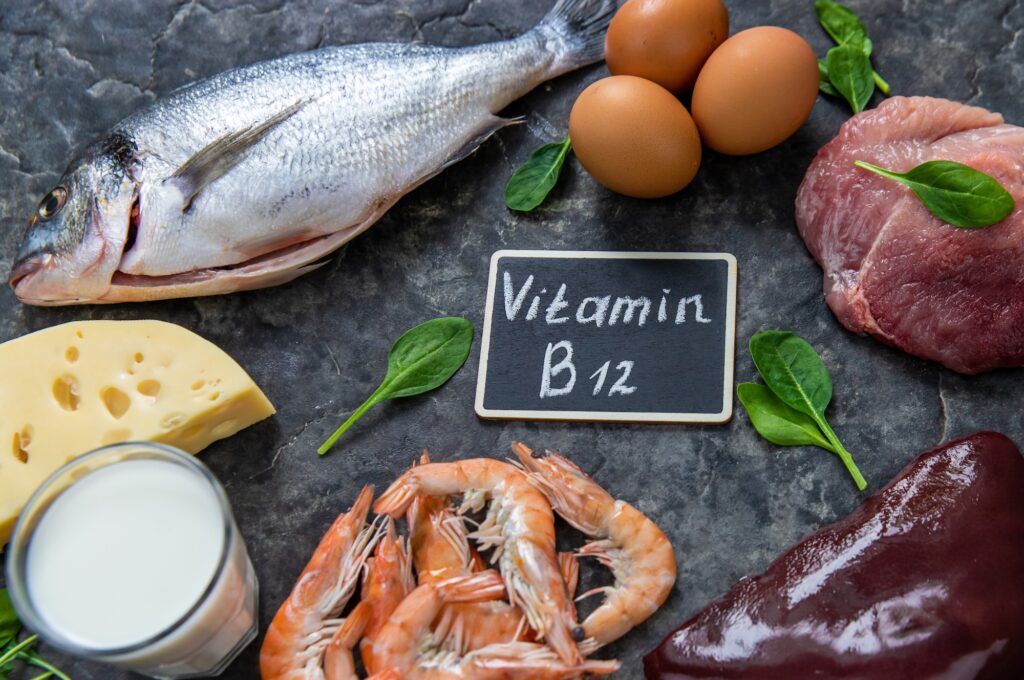
Vitamin B12 is one of the most talked-about — and most misunderstood — nutrients in the wellness world. It plays a role in almost every major system in your body, but a surprisingly large portion of the population doesn’t get enough. And even those who supplement often take the wrong form or the wrong dose for their genetics.
If you’ve ever wondered whether you’re deficient, which form to take, how much you actually need, or why your last B12 supplement made you feel worse instead of better — this guide covers all of it.
The Short Answer
Vitamin B12 (also called cobalamin) is an essential water-soluble nutrient your body needs for energy production, nervous system function, DNA synthesis, and red blood cell formation. Your body can’t make it on its own — you have to get it from food or supplements.
It comes in four main forms in supplements: cyanocobalamin, methylcobalamin, hydroxocobalamin, and adenosylcobalamin. Each has a different absorption profile and fits different bodies depending on genetics.
For most people, a low dose (12-24 mcg, or 500-1,000% of the Daily Value) of the right form is enough. Mega-dose supplements delivering 1,000-5,000 mcg per pill are more marketing than medicine.
What Does Vitamin B12 Actually Do?
Vitamin B12 works with folate (B9) and B6 in a chemical pathway called the methylation cycle — one of the most important processes in your body. Methylation controls:
- Energy production — B12 helps convert food into cellular energy at the mitochondrial level
- Nervous system function — B12 is required to build and maintain the myelin sheath that protects nerve cells
- Red blood cell formation — B12 works with folate to produce healthy red blood cells; without enough, you develop megaloblastic anemia
- DNA synthesis and repair — every cell in your body needs B12 to divide and replicate correctly
- Mood regulation — B12 supports the production of neurotransmitters like serotonin and dopamine
- Homocysteine control — B12 helps convert homocysteine (an inflammatory amino acid) into methionine; high homocysteine levels are linked to heart disease and cognitive decline
When B12 is deficient, all of these processes slow down. That’s why deficiency symptoms can feel so wide-ranging and confusing.
The Four Forms of Vitamin B12 in Supplements
Not all B12 supplements are the same. The form on the label matters more than most people realize.
Cyanocobalamin
The most common and most stable form. Your liver converts it into the active forms your body needs, at whatever pace your genetics allow.
Best for: Most people, especially those who don’t know their gene type. Also the best choice for anyone with slow COMT (the “methyl-sensitive” profile) because it doesn’t add methyl groups to a system that may not clear them well.
Dose range: 12-24 mcg daily (500-1,000% DV) is enough for most people. Some clinical protocols use higher doses to correct severe deficiency, but for maintenance and mild deficiency, moderate is plenty.
Methylcobalamin
The pre-activated methylated form. Marketed heavily as “superior” in recent years — but it works well only for some people.
Best for: People with fast COMT and slow MTR/MTRR variants who genuinely can’t convert inactive B12 well. This is a specific subset — probably 20-25% of adults.
Not ideal for: The roughly 1 in 3 adults with slow COMT variants. In this group, methylcobalamin overloads the methylation cycle and commonly causes anxiety, jitters, insomnia, and racing heart within hours – Learn more here
Dose range: 12-24 mcg daily is plenty for tolerant people. Higher doses often make things worse, not better.
Hydroxocobalamin
Often used in B12 injections. Well-tolerated by most people and stays in circulation longer than the other forms.
Best for: People with CBS gene upregulations (which produce elevated nitric oxide) — hydroxocobalamin helps mop up excess NO. Also a solid middle-ground choice for people uncertain about their genetics.
Dose range: 12-24 mcg daily orally. Injections used in clinical settings run higher.
Adenosylcobalamin
One of the two active forms your body uses inside cells. Supports energy production directly at the mitochondrial level.
Worth noting: when you take cyanocobalamin, your body converts it into both methylcobalamin AND adenosylcobalamin as needed. You don’t have to take the active forms directly to benefit from them — your body makes them on its own at a pace it can handle.
Best for: People whose primary complaint is fatigue and low energy. Rarely needed on its own.
Dose range: 12-24 mcg daily.
Signs You Might Be Low in B12
B12 deficiency is one of the most under-diagnosed nutritional issues in modern medicine, in part because standard blood tests use reference ranges that miss subclinical deficiency and in part because the symptoms overlap with so many other conditions.
Physical signs:
- Persistent fatigue that doesn’t respond to sleep
- Tingling or numbness in hands or feet (early nerve involvement)
- Pale skin
- Shortness of breath on mild exertion
- Heart palpitations
- Balance issues or unsteadiness
- Smooth, sore, or swollen tongue
- Dizziness
Cognitive and mood signs:
- Brain fog
- Memory problems
- Difficulty concentrating
- Anxiety or low mood
- Irritability
- Confusion (especially in older adults)
If three or more of these sound familiar, it’s worth investigating your B12 status — either through supplementation or bloodwork.
Who’s at Risk of B12 Deficiency?
Some groups are much more likely to run low:
People over 40 — stomach acid production declines with age, which reduces B12 absorption. Intrinsic factor (the protein required to transport B12) also declines.
Vegetarians and vegans — B12 is almost entirely found in animal products. Plant-based eaters must supplement.
Anyone taking certain medications — metformin, PPIs (Prilosec, Nexium), H2 blockers (Zantac, Pepcid), and long-term birth control all interfere with B12 absorption.
People with digestive issues — SIBO, IBD, celiac disease, and post-bariatric surgery patients often have impaired B12 absorption.
People with MTHFR and related methylation gene variants — these variants don’t cause deficiency directly, but they affect how your body uses B12 once absorbed, making adequate intake more important.
Chronically stressed people — cortisol and chronic stress deplete B-vitamins across the board.
How Much B12 Do You Actually Need?
The RDA for B12 is only 2.4 mcg per day for adults. That’s the minimum to prevent deficiency, not the amount needed to optimize function.
Realistic supplemental ranges:
- Maintenance for healthy adults: 12-24 mcg daily (500-1,000% DV)
- Mild deficiency correction: 25-50 mcg daily for 2-3 months
- Severe deficiency or malabsorption: clinical intervention, often via injection
Notice what these numbers are NOT. Mainstream B12 supplements commonly deliver 1,000-5,000 mcg per pill — that’s 41,000-208,000% of the Daily Value. Those doses aren’t harmful for most people (B12 is water-soluble and excreted), but they’re not more effective either. Your body uses what it needs and eliminates the rest. Moderate doses, taken consistently, work as well as mega-doses for the vast majority of people.
Food Sources of B12
The best whole-food sources of B12:
- Beef liver (extraordinarily high)
- Clams and shellfish
- Fish (salmon, tuna, trout, sardines)
- Beef and lamb
- Poultry
- Eggs
- Dairy (milk, yogurt, cheese)
- Fortified cereals and nutritional yeast (for plant-based diets)
If you’re eating a varied diet with animal products, you should be getting some B12 daily. The problem is that even people who eat these foods regularly can be deficient if absorption is impaired — which is why supplementation matters especially for older adults, medication users, and anyone with gut issues.
Should You Test Before Supplementing?
If you’re worried about deficiency, the standard blood test for B12 measures serum B12 levels. But there’s a catch: the “normal range” (200-900 pg/mL in most labs) was set decades ago and misses a significant amount of functional deficiency.
More useful tests:
- Serum B12 (basic screening — but note that “normal” is not necessarily “optimal”)
- Methylmalonic acid (MMA) — a more sensitive indicator of B12 status at the cellular level
- Homocysteine — elevated levels suggest B12, B6, or folate insufficiency
- Holotranscobalamin (holoTC) — measures active B12 available to cells
If you’re already symptomatic and want to skip the testing, a moderate-dose B12 supplement is low-risk and often produces noticeable improvement within 2-4 weeks. That’s often the most practical path forward.
How to Choose the Right B12 Supplement
Three things to look for:
1. The right form for your body. For most people, cyanocobalamin at a moderate dose is the safest starting point. Methylated forms work well for a specific genetic subset but cause problems for others.
2. A moderate dose. 500-1,000% DV (12-24 mcg) is enough for the vast majority of people. Skip the 1,000-5,000 mcg mega-dose formulas.
3. A clean base. Look for supplements with minimal additives — no artificial colors, sweeteners, or unnecessary fillers. Liquid or sublingual forms absorb better than swallowed tablets.
Frequently Asked Questions
Is cyanocobalamin safe? I’ve heard it contains cyanide.
The “cyano” in cyanocobalamin refers to a tiny cyanide molecule bound to the cobalamin. Your liver removes it during conversion, and the amount is far below toxic levels — you get more cyanide from eating an apple. It’s the most researched and most stable form of B12 available.
How long does it take for B12 to work?
Most people notice improvements in energy and mental clarity within 2-4 weeks of consistent supplementation. Nerve-related symptoms (tingling, numbness) can take longer — sometimes 2-3 months.
Can you take too much B12?
B12 is water-soluble and generally considered non-toxic. Your body excretes what it can’t use. That said, mega-doses can stress the methylation system in sensitive people, causing anxiety, jitters, or insomnia — especially with methylated forms.
Do I need B12 if I eat meat?
Not necessarily, but many people who eat meat are still deficient due to age-related absorption decline, medication use, or gut issues. Testing or trial supplementation can help you find out.
What’s the difference between B12 and B-Complex?
B12 is one of eight B-vitamins. A B-Complex contains all eight — B1, B2, B3, B5, B6, B7, B9, and B12. If you only need B12 support, a standalone B12 makes sense. If you want broader coverage, a B-Complex is more efficient.
Does B12 need folate to work?
Yes. B12 and folate work together in the methylation cycle. Taking one without the other for extended periods can mask a deficiency of the other. Most B-Complex formulas include both for this reason.
What to Do Next
If you’re just looking to correct a deficiency and don’t have a specific reaction history to B-vitamins, cyanocobalamin at a moderate dose is your safest bet. Try our Liquid Vitamin B12 (Cyanocobalamin) — non-methylated, moderate dose, no fillers or additives.
But if you’re reading this because something else is going on — read this section carefully.
If you have the MTHFR gene and you’ve tried methylated B12 (methylcobalamin), or a “premium” B-Complex from a functional medicine brand, and you felt worse instead of better — anxious, jittery, wired at night, racing heart, unable to sleep — you’re not alone, and you’re not overreacting.
This is one of the most common patterns I see. And the reason it happens has almost nothing to do with your methylation speed. It has everything to do with a second gene called COMT, which controls how fast your body clears methyl groups.
If you have MTHFR combined with slow COMT (which is very common), methylated B-vitamins overload your nervous system instead of supporting it. The popular advice — “if you have MTHFR, take methylated” — is only half the story. And the other half is what’s been quietly making you feel terrible.
If any of that sounds like you – READ THIS
Want to learn how to live healthy, get better sleep, eat healthier, hydrate, get fit, and improve your environment? Sign-up for our free weekly newsletter below.