

The counter-intuitive truth about the vitamin most people take FOR anxiety — and what to do if it’s making yours worse.
If you’ve felt more anxious, more wired, or more on-edge after starting a B-vitamin supplement, you’re not imagining it. B-vitamins — despite being marketed as calming, energy-supporting, and generally “good for stress” — can absolutely cause anxiety in a meaningful percentage of people.
The confusing part: B-vitamins are also involved in producing your body’s calming neurotransmitters (serotonin, dopamine, GABA). So how can something that helps make calming brain chemicals ALSO cause anxiety?
The answer comes down to which FORM of B-vitamin you’re taking, how MUCH of it, and whether your body can process the specific type you’re giving it.
Here’s what’s actually happening — and what to do about it.
The Short Answer
For roughly 1 in 3 adults with slow methylation processing (usually driven by COMT, MAOA, or MTHFR gene variants), the “premium” methylated B-vitamins that dominate the supplement industry — methylfolate, methylcobalamin, P-5-P — can flood the nervous system with more pre-activated methyl donors than the body can comfortably clear.
The result: anxiety, insomnia, heart palpitations, racing thoughts, that “wired but tired” feeling that doesn’t respond to the usual advice about managing stress.
If this describes you, the fix is usually simpler than you think: switch to non-methylated forms of B-vitamins at moderate doses. Your body activates them at its own pace instead of being flooded.
The rest of this article gets into the details — why this happens, how to identify if it’s happening to you, and what to try instead.
Why B-Vitamins Can Cause Anxiety
Three things drive B-vitamin-induced anxiety, and they often compound each other:
1. Methylated Forms Flood a Sensitive System
Standard B-vitamins (folic acid, cyanocobalamin, pyridoxine HCl) require your body to convert them into their active forms before use. This conversion process happens at a rate your body can regulate.
Methylated B-vitamins (methylfolate, methylcobalamin, P-5-P) are pre-activated. Your body skips the conversion step and gets the active form immediately.
For most people, that’s fine. For the roughly 1 in 3 with slow downstream methylation, it’s a problem. Here’s why:
Methylation is a cellular process that happens billions of times per second. It involves adding a methyl group (a small molecule) to other molecules. Your body uses this to activate vitamins, manage neurotransmitters, detoxify, and regulate mood.
When you take methylated B-vitamins, you’re adding a large amount of methyl donors to your system all at once. If your body’s downstream processing enzymes (COMT, MAOA) are slow, those methyl donors don’t get processed and cleared efficiently. They build up. And that buildup drives anxiety.
Specifically, high methylation activity affects the breakdown of catecholamines — dopamine, epinephrine (adrenaline), and norepinephrine. When these stress hormones don’t clear fast enough, you feel wired, anxious, sometimes with racing heart and disrupted sleep.
2. Mega-Doses Amplify the Problem
Walk into any supplement store and pick up a “premium” B-complex. You’ll typically see doses like:
- Vitamin B6: 25-100 mg (often 500-5,000% Daily Value)
- Vitamin B12: 1,000-10,000 mcg
- Folate: 800-1,000 mcg
For most B-vitamins, your body can only absorb and use a modest amount at a time. Anything above that is either excreted (waste) or forces overstimulation.
Two mega-dose issues specifically drive anxiety:
B6 above 100 mg/day has documented neurotoxicity risk — nerve damage that can cause tingling, numbness, and yes, anxiety. This is well-established in medical literature.
B12 above 1,000 mcg is largely wasted — your body’s absorption drops sharply at high doses (called “saturated transport”). But some sensitive people still react to the neurological stimulation of high-dose B12, especially in methylated form.
For sensitive systems, moderate doses (100-500% DV) provide what the body needs without triggering the overstimulation.
3. Genetic Variants Change the Equation
Not everyone reacts the same way to the same B-vitamin. Genetic differences in three enzymes matter most:
MTHFR — Controls folate activation. About 40-50% of people have at least one variant (C677T or A1298C). Most functions fine on standard folic acid.
COMT — Breaks down catecholamines (dopamine, adrenaline). Slow COMT means these stress chemicals hang around longer. This is one of the most common drivers of methylated B-vitamin sensitivity.
MAOA — Breaks down serotonin, dopamine, and norepinephrine. Slow MAOA amplifies the effects of extra neurotransmitters, including those produced by methylated supplementation.
If you have slow COMT or MAOA variants (roughly 1 in 3 adults), methylated B-vitamins put more processing demand on already-slow enzymes. The buildup shows up as anxiety, irritability, insomnia, or a general feeling of being “on edge.”
The Paradox: B-Vitamins Are Also Needed for Anxiety Support
Here’s what makes this confusing: your body genuinely NEEDS B-vitamins to build the neurotransmitters that keep you calm.
- Serotonin synthesis requires B6, folate, and B12
- GABA (your primary calming neurotransmitter) production requires B6
- Dopamine metabolism depends on multiple B-vitamins
- Methylation itself, done at the right rate, is essential for mood regulation
So B-vitamins aren’t the enemy of anxiety. Not having enough of them can absolutely contribute to anxiety and depression. But taking the WRONG forms in the WRONG amounts can cause the same symptoms as being deficient.
The goal isn’t to avoid B-vitamins if you’re anxious. It’s to find the FORM and DOSE that your specific body can use without being overwhelmed.
My Own Experience
I’ll be blunt: I lived this personally.
Years ago I went through a period of significant nervous system sensitivity, and anxiety was one of the hardest parts. Not the “worried about work” kind — the physical, out-of-nowhere kind. Heart racing at 3am for no reason. Restless legs. Feeling wired but exhausted at the same time. The constant vague sense that something was wrong.
I’d been taking a B-complex — my own product, actually. But at the time, the wellness industry was pushing methylated forms hard. Every influencer, every functional medicine practitioner, every “premium” brand was saying methylated was superior. I ordered raw methylated ingredients to evaluate for a potential product reformulation and started taking them myself as a test.
Within days I was worse. Wired in a way I’d never been on my original formula. My nervous system was buzzing in a way that didn’t feel right.
When I dropped the methylated forms and went back to non-methylated, the overstimulation calmed down significantly. But the anxiety still didn’t fully lift. It took me longer than I’d like to admit to realize the supplements were only one piece of the puzzle. The bigger piece was my nervous system itself — and that required a different kind of work.
That work — nervous system regulation practices, sleep discipline, mindset shifts, and specifically learning to sit with anxiety instead of running from it — is what eventually got me through. But it wouldn’t have worked without also fixing the supplement side. Both pieces mattered.
If you’re going through something similar right now, know that it’s real, it’s biological, and there’s a path through it.
How to Know if Your B-Vitamins Are Causing Your Anxiety
Some patterns worth watching for:
1. The timing correlation. If your anxiety noticeably worsened after starting a new B-vitamin (or increasing the dose), that timing is significant. Symptoms can start within hours or take a few weeks to build.
2. The methylated pattern. Check your supplement label. If it lists methylfolate, methylcobalamin, or P-5-P (pyridoxal-5-phosphate), you’re taking methylated forms. Try switching to non-methylated forms (folic acid, cyanocobalamin, pyridoxine HCl) and see if the anxiety improves within 2-4 weeks.
3. The mega-dose pattern. If your B-vitamin contains more than 500% DV of any nutrient — especially if it’s in the 1,000-10,000% range — the dose alone could be driving overstimulation regardless of form.
4. The “improved off, worse on” pattern. If you’ve noticed you feel calmer when you stop taking your B-complex for a few days, and worse when you restart, that’s a strong signal.
5. Specific symptoms cluster. Anxiety with heart palpitations, insomnia, and difficulty relaxing — especially if these all showed up together after supplementation — often points to methylated overstimulation.
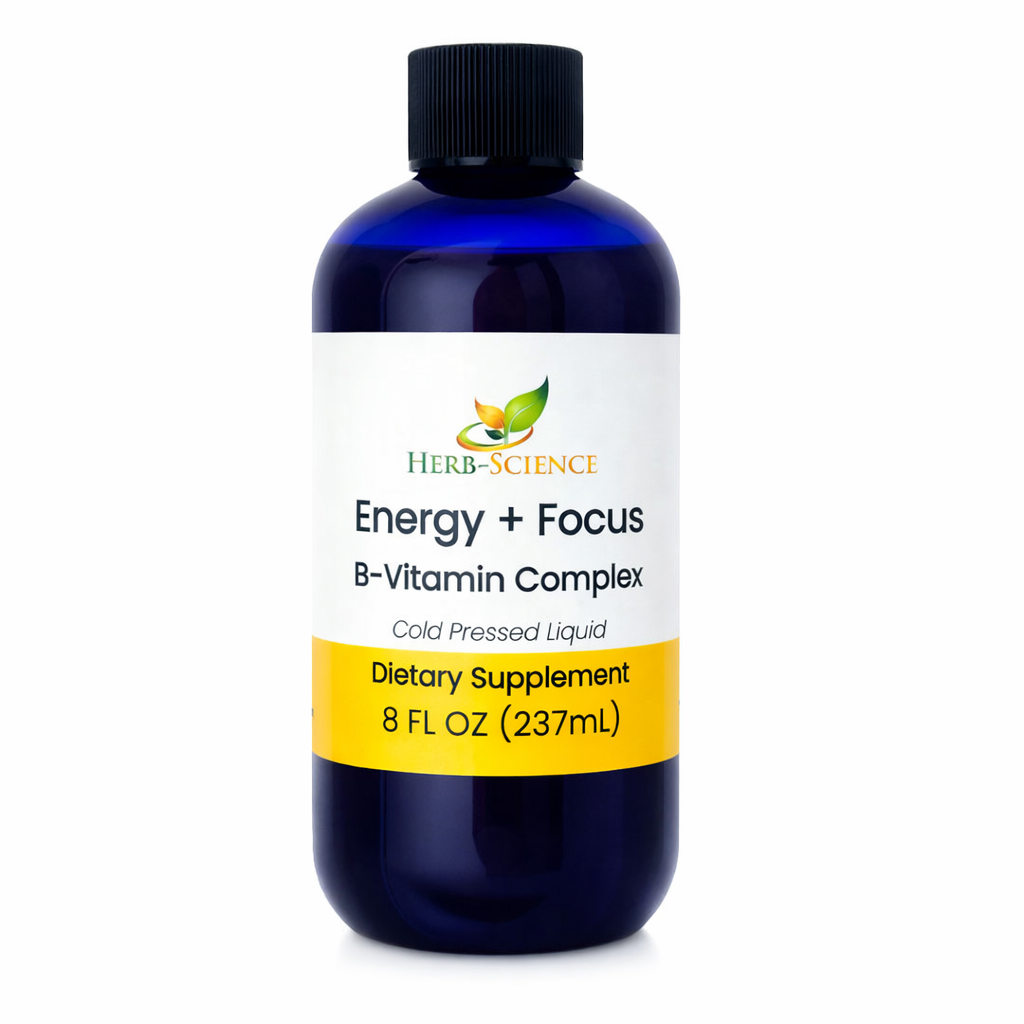
Wondering if this is what’s been happening to you?
Herb-Science Liquid B-Complex is built for the exact scenario I described above — non-methylated forms of all 8 B-vitamins at moderate 500% DV doses, in liquid format so you can adjust drop-by-drop to your own sensitivity level. Built specifically for people whose systems don’t tolerate what the standard supplement industry makes.
See the Herb-Science Liquid B-Complex →
Free shipping · 120-day money-back guarantee
What to Try Instead
If you suspect your B-vitamins are contributing to your anxiety, here’s a practical approach:
Step 1: Stop the current B-vitamin. Give your body a break. Depending on how long you’ve been on the current supplement, you may notice improvement within days or take 2-4 weeks to see full changes.
Step 2: Don’t add anything new right away. Give yourself a baseline. See how you feel without any B-vitamin supplementation for a couple of weeks. This tells you what “off supplements” feels like for you.
Step 3: If you still feel like you need B-vitamin support, try non-methylated forms at moderate doses.
Look for:
- Folate as folic acid (not methylfolate)
- B12 as cyanocobalamin or hydroxocobalamin (not methylcobalamin)
- B6 as pyridoxine HCl (not P-5-P)
- Every dose at 100-500% DV per nutrient
- No TMG, betaine, DMG, or SAM-e (these compound methyl overload)
Step 4: Start low, titrate up slowly.
If you’re sensitive, don’t take the full serving on day one. Liquid formats let you start with a drop or two and increase over 1-2 weeks based on how you feel.
Step 5: Give it time. It typically takes 2-4 weeks to notice initial improvement, and sometimes 2-3 months to fully stabilize.
But B-Vitamins Alone Won’t Fix Anxiety
I want to be honest about something: even the right B-vitamins in the right doses won’t fully resolve anxiety on their own for most people.
Anxiety usually has multiple contributing factors — biological, psychological, environmental, situational. Fixing the supplement side removes one variable. But if your nervous system is dysregulated from chronic stress, poor sleep, unresolved trauma, or ongoing life pressure, no supplement is going to override that.
For a full picture of what helps, the nervous system work matters too:
- Nervous system regulation practices (breathwork, especially the physiological sigh)
- Sleep discipline
- Mindfulness and meditation
- Movement (walking, yoga, gentle exercise)
- Cutting overstimulating inputs (caffeine, news, negative environments)
- Working with a therapist, especially for trauma-informed approaches
- Time in nature
- Nutritional foundation (whole foods, adequate protein, healthy fats)
Supplements are one piece. Lifestyle work is another. Together, they compound in ways that either piece alone doesn’t.
Do You Have The MTHFR Gene?
If you have the MTHFR gene, you’ve likely been told you need methylated forms of your B-vitamins. But that advice doesn’t hold up for everyone with the gene.
If you feel fine on methylated B-vitamins, you’re good to keep going. But if you feel anxiety, jitters, nervousness, trouble sleeping, or anger after taking them — methylated forms aren’t the right fit for your body.
I break down exactly why this happens, and what to do about it, in this article.
Frequently Asked Questions
Can B-vitamins really cause anxiety?
Yes. Specifically, methylated B-vitamins (methylfolate, methylcobalamin, P-5-P) can cause anxiety in the roughly 1 in 3 adults with slow downstream methylation processing (usually COMT or MAOA variants). Mega-doses of any B-vitamin can also drive overstimulation regardless of form.
Which B-vitamin is most likely to cause anxiety?
Methylcobalamin (methylated B12) and methylfolate are the most commonly reported culprits. High-dose B6 (P-5-P or pyridoxine at doses above 100 mg/day) is another frequent trigger and carries additional neurotoxicity risk with long-term use.
How long does it take for B-vitamin-induced anxiety to clear after stopping?
Most people notice improvement within days to 2 weeks after stopping the offending supplement. Full stabilization can take 4-8 weeks depending on how long you were taking it and how sensitive your system is.
Can I take non-methylated B-vitamins if I have MTHFR?
Yes — and for most MTHFR carriers, non-methylated forms actually work better. Heterozygous MTHFR (one variant copy) means your enzyme runs at about 60% efficiency, which is plenty to activate folic acid on its own. Even homozygous MTHFR carriers often tolerate non-methylated forms fine, especially when the whole B-vitamin picture is supported with adequate riboflavin (B2), which is a critical cofactor for the MTHFR enzyme.
Should I avoid B-vitamins entirely if I have anxiety?
Probably not. Your body needs B-vitamins to produce the calming neurotransmitters (serotonin, GABA, dopamine) that support mood regulation. Being deficient can worsen anxiety. The goal is finding the RIGHT form and dose for your body — not avoiding B-vitamins altogether.
How do I know if I have slow COMT or MAOA?
Genetic testing (23andMe, Ancestry, or targeted panels like Genetic Genie’s methylation report) can identify these variants. But you can also often tell by pattern: if methylated B-vitamins consistently cause anxiety, insomnia, or “wired” feelings and non-methylated forms don’t, you likely have slow downstream methylation regardless of what your genes technically show.
The Bottom Line
B-vitamins are essential nutrients your body needs to function well. They also happen to be one of the most misunderstood supplement categories — largely because the wellness industry has spent years pushing methylated forms and mega-doses as “premium” when for a meaningful percentage of the population, those exact choices cause the anxiety they were supposed to solve.
If B-vitamins have made you feel worse instead of better, you’re not imagining it. It’s not your fault. The supplement wasn’t necessarily bad — it just wasn’t built for your particular system.
Try non-methylated forms at moderate doses. Give your body 2-4 weeks to respond. And know that supplements are one piece of the anxiety picture — the nervous system work matters too.
The right approach makes a real difference. Speaking from experience: it can genuinely change how you feel.
— Eli
This article is for educational purposes only and is not a substitute for individualized medical advice. If you’re experiencing significant anxiety, please consult with a qualified healthcare provider.